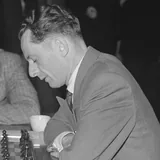
Nicolas Rossolimo
Nicolas Rossolimo played chess the way he sang Russian folk songs — for beauty, and because he could not help it. Born in Kiev, raised between Russia and Greece, made famous in Paris and adopted by New York, he carried the romantic spirit of an older century into the hard professional age and refused to let go of it. He drove a taxi and ran a little chess studio in Greenwich Village; he played the accordion and recorded an album with cover art by Marcel Duchamp; and across the board he produced brilliancies so clean they still circle the world. "I will fight for the art of chess," he said. "I shall not turn into a monster." He never did.
◈Between two homelands
Nikolai Spiridonovich Rossolimo was born on 28 February 1910 in Kiev, then part of the Russian Empire, into a Russian-Greek family of comfortable means. The upheavals of the age scattered such families across Europe, and in 1929 Rossolimo took Greek citizenship, which opened the door to emigration. That same year he left for France.
Paris became the making of him. In the chess cafés of the city between the wars he sharpened a vivid attacking style, and he rose quickly to the front rank of French chess — a Russian voice among the émigrés, playing with a flair that recalled the romantic masters of the previous century rather than the cautious professionals of his own.
◈Champion of France
In 1948 Rossolimo won the Championship of France, and he made the city of Paris his own, taking its championship a record seven times. His tournament play earned a string of brilliancy prizes, awards given for the most beautiful game of an event — a recognition that suited him exactly, for beauty, not mere points, was what he chased.
He measured himself against the giants and did not flinch. He held a lifetime plus score against Max Euwe, the former World Champion, and drew with the likes of Capablanca, Smyslov and the young Fischer. FIDE awarded him the International Master title in 1950 and the Grandmaster title in 1953, the year his strength placed him among the best in the world.
◈The variation that bears his name
Rossolimo's deepest mark on the game is an opening idea. Against the Sicilian Defence he favoured 1.e4 c5 2.Nf3 Nc6 3.Bb5, sidestepping the fearsome tactical mainlines in favour of a calm, strategic battle on White's terms — and he employed it with such conviction and success that the line was christened the Rossolimo Variation.
It was a characteristically civilised choice: an opening that declined to fight chaos with chaos, preferring clarity and long-term pressure. Decades later it is a staple of elite preparation, wheeled out by World Champions, an everyday part of the game's vocabulary. Most who play it have never seen one of his brilliancies — but they speak his name all the same.
◈A new world
In 1952 Rossolimo emigrated again, this time across the Atlantic to New York City. The move did not dim him: in 1955 he won the US Open Championship at Long Beach, California, confirming that the romantic of the Paris cafés could conquer the harder American circuit too.
But chess alone could not keep a grandmaster in mid-century America. To make his living Rossolimo drove a taxi, waited tables, played the accordion and sang — he even recorded an album of Russian songs, its cover designed by his friend the artist Marcel Duchamp. In Greenwich Village he opened the Rossolimo Chess Studio, a salon where ordinary New Yorkers, and notables like Duchamp, could sit down and play the master himself.
◈I shall not turn into a monster
Through every hardship Rossolimo kept his creed. "I will fight for the art of chess," he declared. "I shall not turn into a monster." He refused to reduce the game to a grim hunt for points, and his finest games — flashing queen sacrifices, mating attacks conjured almost from nothing — are his argument made permanent. He set them down himself in his books Les Échecs au coin du feu (1947) and Rossolimo's Brilliancy Prizes (1970).
On 24 July 1975, shortly after finishing third at the World Open, Rossolimo died of head injuries from a fall down a flight of stairs in New York. He was sixty-five. He was buried in a Russian Orthodox cemetery in New Jersey — the wanderer from Kiev, by way of Athens, Paris and Greenwich Village, finally at rest, having kept his promise to the end.
“I will fight for the art of chess. I shall not turn into a monster.”
◈From the archive
◈Legacy
Rossolimo's name is spoken every day at chessboards everywhere, for the Rossolimo Variation of the Sicilian — 1.e4 c5 2.Nf3 Nc6 3.Bb5 — remains one of White's most popular and respected weapons against the most popular opening in chess. But those who knew his games remember the man behind the variation: a multiple winner of brilliancy prizes, French Champion and seven-time champion of Paris, US Open Champion, and an attacking artist who held a lifetime plus score against the former World Champion Max Euwe. He lived the romance he preached — émigré, taxi driver, singer, accordionist, keeper of a Village chess salon where even Duchamp came to play. He died too soon, but he left the game exactly what he promised it: art.