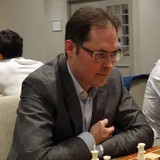
Peter Leko
Peter Leko has spent his life one move from immaculate. He became the youngest grandmaster the world had ever seen at fourteen, and he grew into a player of almost frightening precision — a man who did not blunder, did not flinch, and did not give away half-points he had not decided to give. In 2004 that precision carried him to within a single drawn game of the World Championship itself. He did not take the crown that autumn in Brissago, but he left behind something rarer than a title: the example of a chess player who refused, game after game, to be anything less than exact.
◈The youngest of all
Lékó Péter was born on 8 September 1979 in Subotica, in what was then Yugoslavia, into an ethnic Hungarian family that soon settled in Szeged. He learned chess as a small boy and rose through Hungarian junior ranks with a speed that startled even a country accustomed to producing prodigies — the land that had just given the world the Polgár sisters.
On 1 February 1994, at the age of fourteen years, four months and twenty-two days, Leko earned the grandmaster title, breaking Judit Polgár's record to become the youngest grandmaster in the history of the game. The record would later be broken again and again as the computer age accelerated, but in 1994 it announced, unmistakably, that a new force had arrived.
◈Into the elite
Leko did not flame out as prodigies sometimes do; he matured into a fixture of the world's top ten. He made the venerable Dortmund supertournament his own, winning it in 1999, 2002 and 2008, and added Wijk aan Zee (Corus) in 2005 and the Tal Memorial in 2006 to a long list of elite results. By April 2003 he had climbed to world No. 4, and in April 2005 his rating peaked at 2763.
What set him apart was not flash but flawlessness. He built an opening repertoire as deep and well-kept as any in the world and married it to a technical command that made him agonisingly hard to beat. Other players generated chaos; Leko generated certainty, steering games toward the clear, controlled positions in which his accuracy told.
◈Brissago, 2004
In the autumn of 2004 Leko challenged Vladimir Kramnik for the Classical World Championship across fourteen games in Brissago, Switzerland. It was the summit of his career, and he met it without fear. He drew first blood, and after winning the eighth game he took the lead in the match — carrying it, astonishingly, toward the very last day.
Needing only to hold the final game to become World Champion, Leko faced a Kramnik who had no choice but to win at all costs. The champion broke through in game fourteen, levelling the match at 7–7. Under the rules the drawn match meant the title stayed with the holder. Leko had come within one half-point — a single drawn game — of the crown, and let it slip not through any collapse but through the cruel arithmetic of draw odds.
◈Clean and clear
Leko described his own chess without illusion: "I like to play in a 'clean and clear' way, and I am definitely not the type of guy who takes unnecessary risks." It was a creed, not an apology. He prized soundness over spectacle and trusted that, against a fallible opponent, the player who never erred would be rewarded.
The trainer and author Jacob Aagaard summed up both the gift and its limit: Leko had a superb opening repertoire, was a wonderfully gifted technical player, and was a thoroughly nice man — and had he commanded dynamics as completely as he commanded structure, he would have ranked among the greatest of his age. He remained, instead, something quieter and almost as rare: a player who could be relied upon to be right.
◈The second life
Leko's life off the board was bound up with chess royalty: he married Sofia Petrosián, the daughter of the Armenian grandmaster Arshak Petrosián, who became his lifelong trainer. A vegetarian and a famously even-tempered presence in a high-strung profession, he played ten Olympiads for Hungary and served as a trusted second in World Championship preparation for Anand and Kramnik alike — the consummate insider's insider.
As his own competitive peak passed, he turned that knowledge outward. From 2017 he coached the German prodigy Vincent Keymer, and he became one of the most admired live commentators in chess, his calm, generous, deeply expert voice guiding audiences of hundreds of thousands through the elite events of the streaming era. The boy who had once been the youngest grandmaster on earth grew into one of the game's most trusted teachers.
“I like to play in a 'clean and clear' way, and I am definitely not the type of guy who takes unnecessary risks.”
“Peter Leko has three essential qualities: a great opening repertoire, he is a greatly gifted technical player and a very nice guy. If he had a good understanding of dynamics as well, he would have been one of the greatest players of our time.”
◈From the archive
◈Legacy
Leko's name belongs to two eras of chess. As a prodigy he rewrote the record books, breaking Judit Polgár's mark to become the youngest grandmaster in history; as a mature master he was, for a decade, one of the half-dozen strongest players alive and the equal of any of them on a clear day. His 2004 title match — drawn 7–7, the crown retained by Kramnik only because the champion held the draw odds — stands as one of the closest near-misses the World Championship has known. In his later years he reinvented himself again, becoming both the trainer who guided the German prodigy Vincent Keymer and one of the most beloved and lucid commentators in the game, the warm voice explaining elite chess to a new online generation. He is remembered as the gentleman of the board: clean, clear, and impossible to rattle.