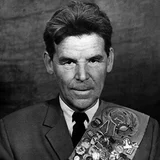
Rashid Nezhmetdinov
He never wore the crown, and he never even carried the grandmaster title — yet Rashid Nezhmetdinov left behind a body of combinations that outlived every champion of his age. Out of a Volga orphanage and the famine of the Russian Civil War he made himself into the most dangerous attacking player the Soviet Union ever produced, a Tatar artist who held a winning lifetime score against Mikhail Tal himself. He came to chess too late, by his own reckoning, to ever be called the best. But across the board, when the pieces caught fire, there was no one more beautiful to watch — and Botvinnik said it plainly: nobody saw combinations the way Nezhmetdinov did.
◈An orphan of the Volga
Rashid Gibyatovich Nezhmetdinov was born in 1912 in Aktyubinsk, on the steppe of what is now Kazakhstan, into a Tatar family that poverty would soon scatter. His parents died when he was a small boy, and the famine that followed the Russian Civil War swept him into an orphanage in Kazan, the Tatar city on the Volga that became his home for the rest of his life. He would later remember almost nothing happy from those years — only, once, the taste of fish soup eaten on the banks of the river.
He found the games that would save him in that orphanage. First it was checkers: he learned the Russian draughts at fifteen, and within the year placed sixth in the national championship, eventually earning the master's title. Chess came later — too late, he always insisted. “I came to chess too late,” he said, “as a 17-year-old man with no theoretical knowledge, whereas all the champions received training from the age of seven or eight.” It was a regret he carried like a stone. But it was also, perhaps, the source of his freedom: he had learned the board not from books but from his own imagination, and he never stopped playing as though every position were a door. “With every game,” he wrote, “a door to a mysterious world of fantasy, adventure, enigma and exact mathematical calculations is opened for me.”
◈The board and the front
Before chess made him famous, Nezhmetdinov made his living at the edges of it — a clerk in a standards bureau, an instructor at a pedagogical institute, a captain of the Spartak sports society's chess team. He never fully abandoned checkers either; after a fifteen-year absence he returned to the draughtboard in 1949 and promptly took second place in the Russian championship, before dismissing the game with a master's disdain, noting that all its contests could in the end be reduced to rook endgames.
The war took him in 1941. Drafted into the Red Army, he served far from the worst of the carnage — posted toward the Mongolian frontier and later to occupied Germany — and survived a conflict that killed more than eleven million Soviet soldiers. In 1946, in uniform still, he won the championship of the Berlin military district with a crushing 14 out of 15. He was thirty-three, and his real chess life was only now beginning.
◈Five crowns of Russia, and a title denied
Through the 1950s Nezhmetdinov was the king of Russian chess. He won the championship of the Russian Federation — the RSFSR, the largest of the Soviet republics — five times: in 1950, 1951, 1953, 1957 and 1958. In 1954 he took second place at the Bucharest international, behind only Viktor Korchnoi, and with it the title of International Master. At the 1957 Soviet Championship in Moscow he beat two future world champions in the same event, downing both Mikhail Tal and Boris Spassky.
And yet the grandmaster title never came. The reasons were partly his own — a defensive game that could waver when there was no attack to be had, and a temperament that craved complications even when the position did not offer them. But they were also, transparently, political. “For some reason, he was very rarely allowed to go abroad,” Korchnoi recalled, “and obviously, he never became a grandmaster because of that.” He left the Soviet Union only three times in his life. As one analyst put it, how was Nezhmetdinov supposed to earn a grandmaster norm in tournaments he was never permitted to play? The honour was withheld; the chess was not diminished.
◈No reverse gear
What Nezhmetdinov had, and almost no one else of his generation possessed in the same measure, was an absolute willingness to burn the boat. He attacked when attack was unreasonable, sacrificed where caution screamed, and trusted his calculation through positions that looked, to everyone else, like ruin. Grandmaster Yuri Averbakh — who held a lopsided record against him by simply refusing him any active game — admitted the danger flatly: “If he had the attack, he could kill anybody, including Tal.”
The proof is in the games, and one above all. At the Russian team cup in Rostov-on-Don in 1962, against Oleg Chernikov, Nezhmetdinov reached a sharp Sicilian where the routine move was a quiet repetition and a draw. Instead he played 12.Qxf6, giving up his queen for two minor pieces and a grip on the dark squares that Chernikov could never break. The pieces did the rest; White won, and the game entered history as one of the greatest queen sacrifices ever played. Four years earlier, on his way to a fifth Russian title, he had sacrificed his queen again to demolish Lev Polugaevsky in a game admirers still call one of the finest attacking masterpieces on record. “Nobody sees combinations like Rashid Nezhmetdinov,” said Mikhail Botvinnik — and from the patriarch of Soviet chess, it was the highest praise there was.
◈Tal's brother in arms
His deepest bond in chess was with Mikhail Tal, the magician of Riga — and remarkably, against the most feared attacker of the age, Nezhmetdinov held a winning lifetime record, a distinction almost no non-champion could claim. The two were not rivals so much as kindred spirits, and when Tal challenged Botvinnik for the world title in 1960, it was Nezhmetdinov he chose as his second. His ideas and his companionship helped Tal unseat the patriarch and become the youngest world champion the game had yet seen.
Tal understood, better than anyone, what his friend was. He did not praise the points or the placings, because those had never been Nezhmetdinov's true subject. “His games reveal the beauty of chess,” Tal said, “and make you love in chess not so much the points and high placings, but the wonderful harmony and elegance of this particular world.” It was the harmony of a man who saw the board as enchantment. “There is nothing more enigmatic than a knight,” Nezhmetdinov once wrote. “Its possibilities surpass any imagination.”
“With every game a door to a mysterious world of fantasy, adventure, enigma and exact mathematical calculations is opened for me.”
“There is nothing more enigmatic than a knight. Its possibilities surpass any imagination.”
“Nobody sees combinations like Rashid Nezhmetdinov.”
“His games reveal the beauty of chess and make you love in chess not so much the points and high placings, but the wonderful harmony and elegance of this particular world.”
“If he had the attack, he could kill anybody, including Tal.”
◈From the archive
◈Legacy
Nezhmetdinov died in Kazan on 3 June 1974, aged 61, and was buried in the city's Arskoe Cemetery. He had spent his last years giving simultaneous exhibitions and coaching at the Kazan chess club, an approachable, joyful man always ready to talk — about anything, but above all about chess. Today the Kazan chess school carries his name, his immortal games are anthologised in Nezhmetdinov's Best Games of Chess and celebrated in Alex Pishkin's Super Nezh, and a new generation discovers the queen sacrifice against Chernikov as a rite of passage. Tal, who loved him, gave him the only epitaph that mattered: “Players die, tournaments are forgotten, but the works of great artists are left behind them to live on for ever.” His favourite phrase, repeated to friends through every setback, was simpler still: our day will come.