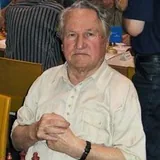
Ratmir Kholmov
Ratmir Kholmov went to sea before he ever went to the board's front rank, and something of the sailor stayed in him: the calm under storm, the refusal to panic when the position pitched and rolled. They called him the Central Defender, and no one in Soviet chess was harder to break. He shared first place in one of the strongest national championships ever held, beat four world champions across his long life, and on one famous night in Havana he beat Bobby Fischer outright. He never played for the world title and was never even crowned champion of his own country — yet many who faced him swore there was no greater natural talent of his generation. Korchnoi said it came from above, the kind Capablanca had.
◈The sailor from the north
Kholmov was born in 1925 in Shenkursk, a small town in the Arkhangelsk region of the Russian north. He learned the moves at twelve. Then came the war, and instead of a chess prodigy's smooth ascent he went to sea: through the Second World War he served in the Soviet merchant marine, working fishing trawlers and cargo ships on the perilous Arctic and Pacific routes.
It was no quiet posting. His ship carried him across to Portland, Oregon and San Diego, California on the Lend-Lease supply runs that kept the Soviet war effort alive. On one return passage the vessel struck a Japanese mine and was interned for weeks near Vladivostok. The wartime years at sea — and the suspicion they later attracted from Soviet authorities — would shadow him for decades. But they also forged the temperament that defined his chess: unflappable, resourceful, at home in heavy weather.
◈The Central Defender
When Kholmov reached the top of Soviet chess, his peers gave him a name that stuck: the Central Defender. No one defended like him. He had an almost unnatural ability to absorb pressure, untangle a cramped position and emerge unscathed where others were crushed — and then, often as not, to strike back, for he was never a mere passive resister but a genuinely dangerous attacker once the danger to himself had passed.
He attributed the defensive gift, with characteristic modesty, to a gap in his game: he was not a great memoriser of opening theory, and so he was forced to solve his problems over the board, by pure calculation and judgement, rather than from a book. “Kholmov does not number among the opening 'erudites',” wrote the masters Baranov and Mikenas — and yet he plunged into theoretical complications without fear. Viktor Korchnoi, not a man given to easy praise, put it more grandly: Kholmov had “outstanding natural talent, the kind that comes from above. This was the kind of talent Capablanca had.”
◈The strongest never crowned
Kholmov reached his first Soviet Championship final in 1948 and took the International Master title in 1954, but recognition came slowly — he was not awarded the Grandmaster title until 1960, and even then Mikhail Botvinnik had at first opposed his nomination. The summit of his career came at the 1963 USSR Championship in Leningrad, one of the deepest national fields in the history of the game, where Kholmov shared first place with Boris Spassky and Leonid Stein. In the three-way play-off it was Stein who prevailed; Kholmov was left, as one account has it, the strongest player of his era never to be Soviet Champion.
That near-miss did not stop him from leaving scars on the very greatest. Across his career he scored wins over four world champions — Tigran Petrosian, Boris Spassky, Bobby Fischer and Garry Kasparov — a roll of honour few players who never contested the title can match. At his peak, around 1960 and 1961, contemporary rating estimates placed him as high as eighth in the world.
◈The night he beat Fischer
The game that fixed Kholmov in chess memory came at the 1965 Capablanca Memorial in Havana. The tournament was famous for a strange circumstance: Bobby Fischer, refused a visa by the United States State Department to travel to Cuba, played the entire event by telex, his moves relayed move by move from a club in New York. Across the board — or across the wire — Kholmov, playing Black in a Ruy Lopez against an opponent who was murderous with the White pieces, simply outplayed him.
Kholmov finished the tournament undefeated, and his victory over Fischer was the jewel of the result. He told the story afterward with a sailor's bluntness: the evening before, he had sat checking a Smyslov variation while drinking Bacardi, and the next day, under heavy pressure throughout, he held his nerve and won. It remains one of the most celebrated single games of his life — proof that the quiet defender from Shenkursk could topple the most feared attacker on earth.
◈A long life over the board
Kholmov's path was never smooth. A drinking incident in 1951, in the company of his rivals Tarasov and Nezhmetdinov, cost him a year's suspension, and the shadow of his wartime captivity kept Soviet authorities wary of letting him travel abroad until the era of perestroika. He bore it all with an unassuming modesty, never trading on his gifts.
What never left him was the playing itself. He competed across five decades, his appetite for the game undimmed by age, and in 2000 — at seventy-five — he tied for the World Senior Championship at Rowy with 8 out of 11. He went on analysing positions almost to the end of his life, finding in chess, as he said, a kind of rescue. He died in Moscow in 2006, eighty years old, the last great representative of a vanished generation of Soviet masters.
“Chess rescues me to this day. Chess is a miracle, of course. A miracle.”
“Outstanding natural talent, the kind that comes from above. This was the kind of talent Capablanca had.”
“Kholmov does not number among the opening 'erudites' — and yet he boldly entered the theoretical complications.”
◈From the archive
◈Legacy
Kholmov died in Moscow on 18 February 2006, aged eighty, still analysing chess almost to the end. “Chess rescues me to this day,” he said late in life. “Chess is a miracle, of course. A miracle.” He is remembered as arguably the strongest Soviet player of the long era from the 1940s to the 1960s never to be crowned Soviet Champion — a defender of legendary stubbornness who was, in the same breath, a genuinely dangerous attacker. He left behind no world title and no school of theory, but he left a record of having beaten the best the game could field, a nickname that captured his art exactly, and the example of a sailor's son who turned a profound natural gift into a life spent, gratefully, over the sixty-four squares.