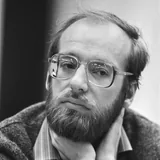
Robert Hübner
He was the strongest player the West produced from the chaos of postwar Germany, and he never quite believed it mattered. Robert Hübner was a papyrologist by vocation and a grandmaster almost by accident — a scholar who decoded crumbling Greek manuscripts and treated the chessboard with the same unforgiving rigour. He climbed to third in the world and stood one match from a shot at the title, then was undone, again and again, not by weaker players but by his own perfectionism and by sheer absurd luck. He beat six World Champions across his career, and to the end insisted he had better things to do than push wood. The contradiction was the man.
◈A prodigy who would rather read
Robert Hübner was born in Cologne on 6 November 1948, and his gift for chess announced itself early: he won the West German Championship at eighteen, and in 1965 shared the Niemeyer tournament for European players under twenty with Hans Ree. The International Master title came in 1969, and the grandmaster title followed in 1971.
But even as a teenager he refused to make chess his whole life. He read classics, and would go on to become a professional papyrologist — a scholar of ancient manuscripts written on papyrus — a discipline demanding exactly the patience, precision and tolerance for ambiguity that marked his play. He spoke roughly a dozen languages and was reckoned one of the finest players of xiangqi, Chinese chess, outside China. Chess, for Hübner, was one rigorous pursuit among several, and never the one he valued most.
◈To the brink of the crown
For all his ambivalence, Hübner became a serious challenger for the world title. He reached the Candidates — the elite stage that decides who plays for the championship — four times between 1971 and 1991, and by July 1981 he stood third in the world on a rating of 2640.
His finest run came in the 1980–81 cycle. He beat András Adorján in the quarterfinal and Lajos Portisch in the semifinal to reach the Candidates Final against Viktor Korchnoi — one match from the right to challenge for the world crown. He even led. And then, with the match slipping from his grasp, he abruptly walked away from it, withdrawing before its end. It was the closest he would ever come, and he could not finish it.
◈Undone by chance and by himself
Hübner's Candidates story reads like a tragedy written by his own temperament. In the 1971 cycle he faced Tigran Petrosian in Seville and, troubled by the playing conditions and the noise, gave up the match after blundering a piece in an otherwise level seventh game. (Petrosian, famously imperturbable and half-deaf, simply played on.) In 1991 his run ended against Jan Timman.
But the cruellest exit came in 1983. His quarterfinal against the former World Champion Vasily Smyslov ran all fourteen games to a dead tie. With no games left to break it, the match was decided by spinning a roulette wheel — and the wheel chose Smyslov. One of the deepest analysts in chess history, a man who left nothing to chance over the board, was eliminated from a World Championship cycle by a casino game.
◈Efficient, ruthless, never satisfied
At his best Hübner was a formidable practical force. The English master Bill Hartston called his technique "efficient and ruthless," and the tournament victories piled up: Houston 1974, a share of Munich 1979 with Ulf Andersson and Boris Spassky, a share of the 1979 Rio de Janeiro Interzonal with Portisch and Petrosian, Chicago 1982, and shared firsts at Biel 1984, Linares 1985 and Tilburg 1985 among the strongest fields of the day.
Yet Hartston also identified what kept him from the very summit: "His perfectionist and rather pessimistic approach prevented him from reaching the very top." Hübner could not let an inaccuracy go, in his own play or anyone's, and the relentless self-criticism that made him a great analyst also made him a fragile competitor. His name lives in the opening books too — the Hübner Variation of the Nimzo-Indian Defence (4.e3 c5 5.Bd3 Nc6 6.Nf3 Bxc3+) bears witness to his theoretical depth.
◈The man of principle
Hübner held his convictions as firmly as his analysis. When anti-doping tests were introduced to chess he found them degrading and pointless — performance-enhancing drugs, he reasoned, could not help anyone calculate a variation — and rather than submit he simply withdrew from the German national team. "I am always happy if my opponent's abilities can fully unfold," he said, "because then I learn more."
He gave generously to the game in other ways: he served as a second to Nigel Short during Short's 1993 World Championship match against Garry Kasparov, helped Germany to the silver medal at the 2000 Olympiad in Istanbul, and produced meticulous analytical studies of the world champions' games and the great nineteenth-century brilliancies. He approached that writing the way he approached his papyri — to get at the truth of the position, whatever it cost him.
“It's true that, to me, chess is not an important activity. I always found my other pursuits more valuable. I felt a need to prove that I was capable of more than simply pushing wood.”
“I am always happy if my opponent's abilities can fully unfold, because then I learn more.”
“Efficient and ruthless. His perfectionist and rather pessimistic approach, however, prevented him from reaching the very top.”
◈From the archive
◈Legacy
Robert Hübner died in Cologne on 5 January 2025, aged 76, after a long illness — the same city where he was born, had studied, and had quietly become the finest German player of the post-war era. He leaves a record almost unique in chess: a genuine title contender who regarded chess as the lesser of his pursuits, a grandmaster who defeated Smyslov, Tal, Petrosian, Spassky, Karpov and Kasparov, yet poured his deepest energy into classical philology and the analysis of others' games. His name survives in the Hübner Variation of the Nimzo-Indian Defence and in a body of analytical writing prized for its honesty and depth. He is remembered as the scholar who came to chess on his own severe terms — and proved he was capable of far more than simply pushing wood.