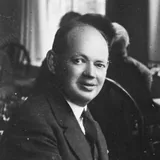
Rudolf Spielmann
While the chess world turned scientific around him, Rudolf Spielmann kept faith with the open attack. He played the King's Gambit when the masters had filed it away as a relic, hurled his pieces forward in search of the brilliancy rather than the point, and lost as gloriously as he won — at Carlsbad 1923 he finished a whole tournament without a single draw. He was no naive throwback: he understood his own art better than anyone, and wrote the book that taught generations what a sacrifice really is. Then history caught him. A Viennese Jew, he fled the Nazis from country to country, and died alone in a Stockholm winter, the warmest attacker in chess gone cold and nearly forgotten.
◈A son of Vienna's coffeehouses
Rudolf Spielmann was born in Vienna on 5 May 1883, into a large and literate Jewish family — his father Moritz was a journalist, and the household ran to brothers and sisters in a city then at the height of its café-chess golden age. The smoke-filled Viennese coffeehouses were the finest finishing school a young master could have, and Spielmann came up through them in the company of Réti, Tartakower and the rest of a brilliant Austro-Hungarian generation.
He turned professional early and never looked back, entering some hundred and twenty international tournaments across four decades. By the years before the First World War he was already a feared attacker, and his name appeared on the prize lists of the strongest events in Europe. Chess was not a hobby he set beside a career; it was the whole of his life, and he gave it everything he had.
◈The last knight of the King's Gambit
Spielmann was a romantic born a generation too late. Where his contemporaries were dismantling the old open gambits in favour of slow positional science, he clung to the King's Gambit, the Vienna Game and the Center Game — he was, in fact, the last great master to wheel out the Center Game in serious play. He pursued the attack for its own sake, willing to risk everything on a combination that might not be sound so long as it left the man across the board reeling.
His devotion had its perfect stage at Abbazia in 1912, a thematic tournament in which every game had to open with the King's Gambit — and Spielmann won it. The same romantic temperament produced his most extreme result at Carlsbad 1923: across seventeen rounds he scored five wins and twelve losses and not one draw, an all-or-nothing record no calculating professional would ever post. Réti caught him exactly: “Spielmann is the last bard of the Gambit Game, and what he wanted to revive especially was the King's Gambit.”
◈Among the giants
For all the losses that came with his daring, Spielmann was no mere entertainer — through the 1920s he stood among the ten best players in the world. His crowning result was Semmering 1926, one of the strongest tournaments of the decade: the favourite was the rising Alexander Alekhine, but it was Spielmann who finished first with 13 of 17, a half-point clear of the future World Champion.
Even the seemingly invincible could not relax against him. Against José Raúl Capablanca — a man who once went years without losing a single game — Spielmann held a remarkable lifetime score of two wins, two losses and eight draws, beating the Cuban at Bad Kissingen in 1928 and again at Carlsbad in 1929. Across his career he carried off first prize in some thirty-three tournaments, from Abbazia and Stockholm to Pistyan and Semmering, always by way of the boldest road on the board.
◈The art of sacrifice
In 1935 Spielmann gave chess its enduring meditation on his own creed: The Art of Sacrifice in Chess. Rather than simply collect brilliancies, he dissected them — separating the real sacrifice, an investment of material for lasting and often unclear compensation, from the sham sacrifice that merely forces a calculated sequence to a known end. It remains a classic, the book through which countless players first learned to think about giving material away; the young Tigran Petrosian, of all people, bought it as a boy and kept it among the works that shaped him.
Spielmann also understood, with rare clarity, the one thing he could not do. Watching Alekhine conjure attacks out of quiet openings, he confessed: “I can comprehend Alekhine's combinations well enough; but where he gets his attacking chances from and how he infuses such life into the very opening — that is beyond me.” He could see the combinations as well as anyone alive; he simply could not always reach the positions in which they bloomed. It was the honest self-knowledge of a true artist.
◈A fugitive without rest
History had no mercy on the gentle attacker. As a Viennese Jew, Spielmann watched the shadow of Nazism fall across his homeland and fled — first to the Netherlands, then to Prague, and at last, in 1939, to Sweden. He had hoped to reach England or America, but doors closed in front of him, and the world that had applauded his brilliancies in a hundred tournament halls now could not find him a place of safety.
His family was torn apart: his brother Leopold died in the Theresienstadt ghetto and his sister Irma in a concentration camp. Alone in Stockholm, increasingly poor and withdrawn, Spielmann shut himself away in his apartment, and in August 1942 he was found dead at the age of fifty-nine. The man who had given chess its warmest fire died, in the end, in the cold.
“I can comprehend Alekhine's combinations well enough; but where he gets his attacking chances from and how he infuses such life into the very opening — that is beyond me. Give me the positions he obtains, and I should seldom falter.”
“In almost every game he played against me he invented something new, and I would find myself in a lost position against him without knowing exactly how it had happened.”
“Spielmann is the last bard of the Gambit Game, and what he wanted to revive especially was the King's Gambit.”
“Spielmann is, in fact, the hardest-working of all the masters, continually searching out the flaws in his game.”
◈From the archive
◈Legacy
Spielmann died in Stockholm on 20 August 1942, aged 59 — officially of heart failure, but a broken refugee living in poverty and near-isolation, the fire of his chess long behind him. He had fled Vienna ahead of the Anschluss and wandered through the Netherlands and Prague before reaching Sweden in 1939; his brother Leopold perished in Theresienstadt and his sister Irma in a concentration camp. His memoir, Memories of a Chess Master, was repeatedly delayed and never appeared, and his gravestone was inscribed, by report, “a fugitive without rest, struck hard by fate.” Yet the work outlived the sorrow. The Art of Sacrifice in Chess is still in print and still studied; the Spielmann–Indian preserves his name in the openings; and he endures as the great romantic who proved, move after move, that beauty and danger were worth more than a safe half-point.