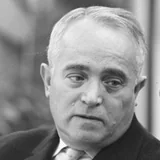
Salomon Flohr
For one shining decade he was next in line for the throne, and then history closed the door. Salo Flohr rose out of the cafés of Prague to become, by the mid-1930s, the second-strongest player alive and the man chess had chosen to challenge Alekhine for the World Championship. The match was signed in spirit and certain in logic — and it never happened. The stake money would not come, and then the tanks did. Flohr, twice a refugee from the century's cruelties, spent the rest of his life as the great challenger who was never allowed to play, the elegant Czech master whose name survives in a dozen opening variations and in the endgames Botvinnik copied into his notebook. He is chess's most poignant might-have-been: a king without a crown, denied not by a rival but by the world.
◈Orphaned by the first war
Flohr was born in 1908 in Horodenka, a town in the Galician corner of Austria-Hungary that is now part of Ukraine, into a Jewish family. The First World War destroyed that family: his parents were killed in the violence that swept the region, and Salo and his brother fled west, refugees as children, settling in Czechoslovakia.
He had nothing to inherit but his own mind, and chess became the making of him. In the cafés of Prague he taught himself into a master, playing for stakes and reputation, and by his early twenties he had emerged as the finest player Czechoslovakia had ever produced — slim, immaculately dressed, famously cool at the board. He was a self-made man in the most literal sense, and the country adopted him as its own.
◈The golden decade
The 1930s belonged, for a while, to Flohr. He won the Hastings Christmas Congress three years running — 1931/32, 1932/33 and 1933/34 — the premier event on the international calendar. He took match play seriously and excelled at it, defeating Gösta Stoltz and Mir Sultan Khan in head-to-head matches, and drawing level, hard-fought contests with Max Euwe in 1932 and with the rising Soviet star Mikhail Botvinnik in 1933. At Moscow 1935 he shared first place with Botvinnik himself.
His style was the opposite of flashy and all the more admired for it: a polished positional player and a peerless technician of the endgame, content to accumulate the smallest advantages and convert them with absolute precision. "It's much easier for me," he once said, "to calculate a forced ten-move combination than to find one best move in a strategically simple position." By the Chessmetrics reckoning he stood at world No. 2 in 1935. He was, briefly, everything a champion-in-waiting should be.
◈Nottingham, and the scalps of champions
The peak of that decade came at Nottingham in 1936, one of the strongest tournaments ever assembled — Capablanca, Alekhine, Euwe, Lasker, Botvinnik and the young Americans all in a single hall. Flohr more than held his own, and in the space of a few days he beat two of the men whose names defined the game: the great Capablanca, and the aged Emanuel Lasker, first of all the World Champions, still formidable in his late sixties.
To stand in that company and take the scalps of both a reigning legend and the patriarch of the modern game was to announce, plainly, that Flohr was of championship class. The chess world agreed. The only question that remained was when, and against whom, he would play for the title itself.
◈The challenger the world denied
By 1937 the answer seemed settled: FIDE designated Salo Flohr the official challenger to World Champion Alexander Alekhine. It was the recognition of everything the decade had built. And then it dissolved. The enormous stake money such a match demanded could not be raised, and the political weather was turning black — within a year Flohr's adopted Czechoslovakia would be carved up and occupied, and a Jewish grandmaster from Prague had far more than chess to fear.
At the great AVRO tournament of 1938 — the only time the world's top eight were gathered to fight it out at once — Flohr, distracted and exhausted by the gathering catastrophe, finished last, and his title hopes ended there. He fled again, as he had as a child, this time eastward to the Soviet Union in 1939, becoming a Soviet citizen in 1942. He had been within reach of the summit of chess, and the world had taken it away before a single move of the match was made.
◈The writer and the master of endings
The war and the years that followed turned Flohr from contender into elder statesman. The sharper, more violent Soviet generation overtook him at the board — he qualified for the 1950 Candidates Tournament but finished near the bottom — yet he found a second vocation that made him beloved across the chess world. He became one of the finest chess journalists of his time, writing warm, witty, humane columns for Ogonek and the Soviet press, and he served the game as an International Arbiter from 1963.
His fingerprints stayed on the board long after he left the front rank. He was instrumental in raising the Caro-Kann Defence from an obscurity to a respected weapon, and his name attached itself to variations across half a dozen openings — the Flohr–Zaitsev system of the Closed Ruy Lopez was still being wheeled out by Anatoly Karpov in World Championship play in the 1980s. Botvinnik paid him the deepest professional compliment of all: many of the endgames Flohr played in the thirties, the future World Champion admitted, lived on in his own notebook of essential positions. Flohr died in Moscow in 1983.
“It's much easier for me to calculate a forced ten-move combination than to find one best move in a strategically simple position.”
“Many of the endings which Flohr played in the thirties figured in my notebook of key endgame positions.”
◈From the archive
◈Legacy
Salo Flohr gave chess a decade of flawless technique, a model of how to win an endgame, and a clutch of opening ideas — the Caro-Kann's rehabilitation, the Flohr–Zaitsev Ruy Lopez — that outlived him by generations. But he is remembered most for the title match the world would not let him play: the orphan of one war who climbed to within a single step of the championship, only to have the next war close the door. He answered that loss the way he had answered the first one, by remaking himself — into the warmest chess writer of his era and a custodian of the game's endgame wisdom. He remains chess's great uncrowned challenger, proof that the line between a champion and a footnote can be drawn by history rather than by talent.