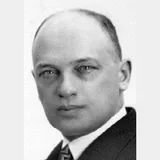
Savielly Tartakower
Savielly Tartakower never won the world title, and he would have been the first to make a joke of the fact. He was something rarer than a champion: a doctor of law who soldiered in two world wars, a polyglot who gambled away his winnings at the roulette wheel, and the wittiest man ever to sit at a chessboard. With Réti and Nimzowitsch he tore up the old rulebook and called the result hypermodern — and then he wrote it all down in prose so quotable that a century later players still trade his sentences like proverbs. He gave the game new openings, new books, and a new way of laughing at its cruelties. “Erro, ergo sum,” he said — I err, therefore I am — and no one has ever described the chessboard, or the human being bent over it, more honestly.
◈An Austrian boy in a Russian city
Tartakower was born in 1887 in Rostov-on-Don, the son of well-to-do Austrian Jews who ran a textile business in the Russian port city. His was a comfortable, cultured childhood — until 1911, when both his parents were killed during a break-in at their home. He was a young man, already abroad at his studies, when the world that raised him was wiped out in a single night of violence.
He had gone west to read law, taking doctorates at the universities of Geneva and Vienna. He was a natural linguist, fluent in German and French, equally at home in the cafés of Vienna and the salons of Paris — though, in one of the small ironies of his life, he never learned a word of Polish, even after Poland became the country he would represent before the world. Chess, which he had taken up seriously as a student, slowly became the thread that ran through everything else.
◈The hypermodern revolution
In the years after the First World War, Tartakower joined Richard Réti and Aron Nimzowitsch in the movement that would overturn classical chess. Where the old school taught that the centre must be occupied with pawns, the hypermoderns argued it could instead be controlled from a distance — invited forward, then attacked and undermined. Tartakower gave the revolution its name and its bible: Die hypermoderne Schachpartie (“The Hypermodern Game of Chess”), published in 1924, ran through edition after edition and taught a generation to think in the new style.
He was a restless inventor of openings. At the Barcelona tournament of 1929 the organisers asked him to devise a variation in homage to the region's chess heritage; the system he produced — 1.d4 Nf6 2.c4 e6 3.g3 — is still played at the very highest level today as the Catalan Opening. Five years earlier, at the great New York tournament of 1924, he had amused himself by opening a game 1.b4 the morning after admiring a great ape at the city zoo, and christened it the Orangutan. The solid Tartakower Defence of the Queen's Gambit Declined still carries his name, as do variations in the Dutch and the Caro–Kann. Few players have left their fingerprints on so many corners of the opening books.
◈Tournaments and the flag of Poland
Tartakower was a fixture of the elite circuit for four decades. He won at Hastings in 1927 and again in 1928, shared first place with Nimzowitsch at London 1928, and took the strong Liège tournament of 1930 ahead of a field that included Mir Sultan Khan. He was twice champion of Poland — at Warsaw in 1935 and Jurata in 1937 — and, as a naturalised Frenchman in his sixties, champion of France at Paris in 1953.
His deepest loyalty on the board was to the Polish national team. He led it through six Chess Olympiads between 1930 and 1939, captaining and training the squad and helping organise the 1935 Olympiad in Warsaw. On the top boards he was formidable: at Hamburg 1930 he took individual and team gold, and at Prague 1931 individual gold again. When Poland's young Miguel Najdorf rose to greatness, he never stopped calling Tartakower “my teacher.” Watching the 1939 Buenos Aires Olympiad, José Raúl Capablanca wrote of the Polish captain as “a master with profound knowledge and great imagination” — adding, drily, that luckily for everyone else the team had only one Tartakower.
◈The soldier and the bohemian
Twice the century called Tartakower away from the board to fight in its wars. In the First World War he served as a staff officer in the Austro-Hungarian army on the Russian front. In the Second, after the 1939 Buenos Aires Olympiad ended with Europe already aflame, he could have stayed safely in Argentina; instead he made his way back to France and joined Charles de Gaulle's Free French forces, serving under the cover name Lieutenant Cartier.
Off the battlefield he lived like a character from a novel. He was a compulsive gambler who poured his tournament prizes into the casinos of Europe and was, by the end, often broke. He was deeply superstitious, and chess folklore remembers the battered old hat he would produce only for the final round of a tournament — where, the story goes, he always seemed to win. Colleagues nicknamed him “Tartacaviar.” When Capablanca told him after a hard-fought draw that his play was “lacking in solidity,” Tartakower shot back: “That is my saving grace.”
◈The writer and the wit
If Tartakower the player belongs to chess history, Tartakower the writer belongs to literature. He was among the finest chess journalists of his age and the author of books that have never gone out of print: the Bréviaire des Échecs (“A Breviary of Chess”), the two great anthologies 500 Master Games of Chess and 100 Master Games of Modern Chess compiled with Julius du Mont, and his own My Best Games of Chess, 1905–1954.
But it is his sentences that survive best — the “Tartakoverisms” that every chessplayer eventually learns by heart. “The winner of the game is the player who makes the next-to-last mistake.” “An isolated pawn spreads gloom all over the chessboard.” “The blunders are all there on the board, waiting to be made.” “It's always better to sacrifice your opponent's men.” The chess historian Harry Golombek, who knew them all, called him “far and away the most cultured and the wittiest of all the chess masters I have ever met.”
“The winner of the game is the player who makes the next-to-last mistake.”
“An isolated pawn spreads gloom all over the chessboard.”
“The blunders are all there on the board, waiting to be made.”
“It's always better to sacrifice your opponent's men.”
“Dr. Tartakower is far and away the most cultured and the wittiest of all the chess masters I have ever met.”
“The Polish team is captained and led by Dr S. Tartakower, a master with profound knowledge and great imagination. Luckily for the others, the Polish team has only one Tartakower.”
◈From the archive
◈Legacy
Tartakower died in Paris in February 1956, seventeen days short of his sixty-ninth birthday, his prize money long since lost to the roulette table. He left behind no world title — but he left the openings that still bear his name, the books that still teach the game, and a body of wit that has outlived nearly everything else from his era. More than any champion, he gave chess its self-knowledge: the understanding that the game is, as he put it, “a fairy tale of 1001 blunders,” and that to play it at all is to err, and to err is simply to be human. Erro, ergo sum.