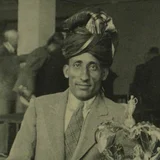
Sultan Khan
He could not read or write, had never opened a chess book, and learned the European game only in his twenties — yet within five years Mir Sultan Khan was beating the finest players on earth, then vanished back into a Punjab wheat field as completely as he had appeared. Brought to London in the service of a Nawab, he won the British Championship three times, defeated a former World Champion across the board, and was reckoned among the ten strongest players alive. No one has ever risen so far, so fast, on so little instruction. His is the strangest and most quietly heartbreaking story in the history of the game: a genius lent to chess for half a decade and then taken away.
◈A servant of the Nawab
Sultan Khan was born around 1903 — the sources differ between 1903 and 1905 — in the village of Mitha Tiwana, in the Punjab of British India, into an Awan family of small landlords and holy men. His father taught him the Indian form of the game at the age of nine; its rules are not those of European chess, and the boy grew up mastering a different discipline entirely. By his early twenties he was reckoned the strongest player in the Punjab.
Around that age he entered the household of Sir Umar Hayat Khan, a wealthy Nawab and colonel who recognised the talent in his servant and set about converting it. Sir Umar had him taught the Western rules and entered into competition, and in 1928 Sultan Khan won the all-India championship with eight wins, a single draw, and no defeats. The Nawab decided to take his prodigy to Europe.
◈Five years in Europe
He arrived in London in the spring of 1929, and his first tournament went badly — he was a man playing an unfamiliar game in an unfamiliar country, with only rudimentary English and an interpreter at his side. William Winter and Frederick Yates took him in hand. Within months he had won the British Championship of 1929, to the astonishment of a chess establishment that had never seen anything like him. He would win it again in 1932 and 1933 — three titles in four attempts.
He played first board for England at three Chess Olympiads — Hamburg 1930, Prague 1931 and Folkestone 1933 — facing the world's elite on the top board of a great chess nation, a servant from the Punjab representing the empire that ruled his homeland. Through it all he could not read or write; he kept his scoresheets in Hindustani and never studied a single book on the game.
◈The wins that stunned the masters
The measure of him is in whom he beat. At the Hastings Christmas Congress of 1930–31 he defeated José Raúl Capablanca — the former World Champion, one of the most gifted players who ever lived — in a long, technical endgame. Capablanca, it is reported, called him a genius, an accolade the Cuban bestowed on almost no one.
At the Prague Olympiad of 1931, playing first board, he beat both Akiba Rubinstein and Salo Flohr, two of the era's towering figures, while holding Alekhine, Kashdan, Grünfeld and Bogoljubow to draws. That same winter he won a match against Savielly Tartakower by the narrowest of margins, +4 −3 =5. He lost a closer match to Flohr in 1932, but took a game from him even there.
He did all of it, as the historians David Hooper and Kenneth Whyld observed, without ever truly mastering the openings — for opening theory is empirical and cannot be reasoned out from first principles. His strength lay everywhere else.
◈The art without the book
Sultan Khan was a positional player of profound natural instinct. He had, Hooper and Whyld wrote, few peers in the middlegame and ranked among the world's two or three finest in the endgame — patient, solid, prophylactic, content to refuse complications and to grind out advantages others could not see. He distrusted sharp tactical adventures and trusted, instead, the slow logic of a sound position.
What makes the achievement almost unbelievable is its foundation: nothing. No library, no theory, no decades of study. Arpad Elo, calculating backwards, put his peak strength at around 2530 — top-ten in the world — built entirely on raw understanding and the experience of a few hundred serious games. Hooper and Whyld called him perhaps the greatest natural player of modern times, and the phrase has stuck because no one has found a better one.
◈Freed from prison
The cost was written on his body. The damp English climate ravaged him — malaria, influenza, chronic throat infections — and he often arrived at the board with his neck swathed in bandages, a sick man holding his own against the healthiest minds in chess. He was never at home in Europe, and Europe was never quite at home with him.
At the end of 1933 Sir Umar took him back to India, and his international career was simply over — five years, and then silence. A fellow servant, Miss Fatima, remembered that on returning home he felt as though he had been freed from prison. He went back to his land and his family and let the chess world forget him. His granddaughter Atiyab Sultan has written against the temptation to cast people of colour as illiterate savages defying gravity — to dehumanise them — rather than accept the harder truth: that he succeeded purely on merit, the equal of any master of his age.
“They should do something more useful with their lives.”
“Perhaps the greatest natural player of modern times.”
“It can be tempting for a certain class of writers to cast the achievements of people of colour as extraordinary and miraculous, and so they seek to dehumanize them as illiterate savages defying gravity, because the truth that they could succeed purely on merit is too hard to bear.”
◈From the archive
◈Legacy
Returned to India at the end of 1933, Sultan Khan never played serious chess again. When his patron Sir Umar Hayat Khan died in 1944 he settled on his ancestral land at Sargodha, farmed, raised eleven children, and declined to teach any of them the game — telling them, his son Ather recalled, that they should do something more useful with their lives. He died of tuberculosis on 25 April 1966, aged about sixty-two. For decades he was remembered, when at all, as a colonial curiosity. His descendants have since reclaimed him — his son Ather a graduate of the London School of Economics and Inspector-General of Police for Pakistan, his granddaughter Atiyab a Cambridge PhD — and in 2026 the family published Endgame of Empire: Sultan Khan, Asia's First Grandmaster (Fordham University Press). On 2 February 2024, fifty-eight years after his death, FIDE made him an Honorary Grandmaster: the first player of South Asia, and one of the first people of colour, to stand among the masters of the world.