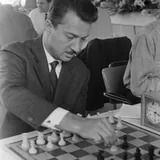
Svetozar Gligorić
Before there was Bobby Fischer, there was Gliga — and for a long generation he was the one man from outside the Iron Curtain who could look the Soviet chess machine in the eye and not blink. Svetozar Gligorić learned the game with his nose pressed to a tavern window and his first pieces carved from wine-bottle corks, fought the German occupation of his country as a teenage partisan, and came out of the war to become the strongest player anywhere outside the Soviet Union. He gave Yugoslavia a folk hero, gave the King's Indian Defence its deepest student, and gave chess a quiet gentleman's creed — that you play against the pieces, never the person across the board.
◈The boy at the tavern window
Gligorić was born in Belgrade in 1923 into poverty, and into a household with no use for the game that would make him famous. His father died when he was nine. On the walk home to the family's attic apartment he would stop at a tavern near the corner and press himself against the glass to watch the players inside. “Pressed against the window, I stared at what seemed to me a magical, mysterious contest on the other side of the glass,” he wrote much later. “That daily ritual of longing lasted two or three years.” He learned the rules, by his own account painfully late, at about eleven — taught in part by a boarder his mother had taken in.
A broken arm at thirteen pulled him away from football, his first love, and pushed him deeper into chess. Too poor to buy a set, he carved his pieces from wine-bottle corks and drew a board with school ink — the same improvised beginning that the Estonian master Paul Keres had known. He cut annotated games out of newspapers to build a library of his own, and at fifteen he won his first tournament, at the Belgrade Chess Club. After his mother's death he was taken in, at seventeen, by Dr. Niko Miljanić, president of the club for which he played.
◈The partisan
Then came the war. When German forces overran Yugoslavia, Gligorić joined the Partisan resistance and fought in the field. The story of how he survived is almost too fitting: a chance meeting with a chess-loving partisan officer led to his being pulled out of frontline combat duty. He came home when the country was liberated, and threw himself back at the board to make up the years the war had taken.
He made them up quickly. At Warsaw in 1947 he finished ahead of the Soviet stars Vasily Smyslov and Isaac Boleslavsky, announcing himself as a force of genuinely international weight. The International Master title followed in 1950 and the Grandmaster title in 1951 — making Gligorić, after Boris Kostić, only the second grandmaster his country had ever produced. He decided then to give himself completely to chess.
◈The best of the West
For the next two decades, in the depths of the Cold War, Gligorić was the strongest chess player in the world outside the Soviet Union — until a teenage Bobby Fischer arrived to dispute the claim. He won the Yugoslav Championship a record eleven times between 1947 and 1966, and finished in the national top three an unmatched eighteen times. His tournament record reads like an atlas: Mar del Plata, Stockholm, Dallas, Belgrade, Manila, Lone Pine, and a record five victories at Hastings. Through him a small country became, for a time, the second power of the chess world.
On the great stage he was relentless. Across fifteen Chess Olympiads he won twelve team medals — a record — and at Munich in 1958 he took the individual gold medal on board one, finishing ahead of the reigning World Champion Mikhail Botvinnik and the former champion Max Euwe. He reached the Candidates Tournaments of 1953, 1959 and 1968, chasing the world title without ever quite catching it; after one event in which he finished ahead of Bronstein, Najdorf and Keres, David Bronstein rated him among the three best players alive. In 1970, when Belgrade staged the USSR versus the Rest of the World match, Gligorić sat on board five for the world team. At the 1966 Havana Olympiad his games were followed from the front rows by Fidel Castro and Che Guevara. Over his career he beat six men who held the world crown — Euwe, Botvinnik, Smyslov, Tal, Petrosian and Fischer among them — twenty-four times.
◈I play against the pieces
Unlike so many chess geniuses, Gligorić was no eccentric. He was a decent, courteous man, and he carried that temperament to the board, where he said he played against wooden pieces rather than against people — the conviction that gave his autobiography its title, I Play Against Pieces. He fought the position, not the person.
What he fought with was theory. Gligorić became the world's leading authority on the King's Indian Defence, and his name is still stamped on the openings he reshaped: the Gligorić Variation and the celebrated Mar del Plata Variation of the King's Indian — the latter born at Mar del Plata in 1953, where he debuted it and won against both Miguel Najdorf and Erich Eliskases — along with the Gligorić System of the Nimzo-Indian and the Gligorić Variation of the Ruy Lopez. Armed with the King's Indian as Black, he was a particular torment to the young Fischer, who could not solve him in that opening or in the Sicilian Najdorf.
◈Journalist, author, composer
Chess was only one of Gligorić's lives. Fluent in several languages and trained as a journalist, he wrote columns for Chess Review and Chess Life and contributed for years to the Chess Informant; his 1972 book on the Fischer–Spassky “Match of the Century” in Reykjavík became a bestseller, translated into language after language and sold in the hundreds of thousands. When the chess world needed an arbiter it could trust, it turned to him: he was the chief arbiter of the marathon, ultimately aborted, 1984–85 World Championship match between Karpov and Kasparov.
His last passion was music. In his eighties he began taking lessons in harmony, and he composed in earnest, releasing a CD of his own work — jazz, blues, ballads, even a touch of rap — in 2011. He drew the parallel himself, between the two disciplines that had filled his life: “Each note is a move, and from these elements you create your own architecture with known rules.”
“I play against pieces.”
“Each note is a move, and from these elements you create your own architecture with known rules.”
“Svetozar was a fair sportsman and a real gentleman, very respected throughout the world. I often crossed blades with him. He had character and was a very strong player.”
“Highly esteemed by friends and opponents, ‘Gliga’ became a folk hero in his native Yugoslavia. He was one of the strongest players on the planet after the Second World War.”
◈From the archive
◈Legacy
Gligorić died in Belgrade on 14 August 2012, aged 89, after a stroke, and was laid to rest in the Alley of the Greats at the city's New Cemetery; the New York Times and obituarists across Europe carried tributes to the most famous grandmaster the Balkans ever produced. He holds the record for Yugoslav Championship titles and was one of the most decorated Olympiad players in history. Yugoslavia had named him its best athlete of 1958, and the honours kept coming long after his death: in 2019 FIDE established the Fair Play Svetozar Gligorić Trophy, awarded each year for sportsmanship and ethics over the board, and in 2020 Serbia placed him on a postage stamp among its Chess Giants. He is remembered as a top-ten player, a peerless opening theoretician, an eloquent journalist and a true gentleman — the boy from a Belgrade attic who carved his pieces from corks and grew up to stand level with the giants of the Soviet age.