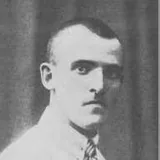
Vasily Panov
Vasily Panov gave chess two gifts most masters never manage even one of. The first was a single sharp idea against the Caro-Kann — push the c-pawn, open the lines, attack — that bears his name to this day on boards from beginners' clubs to world championships. The second was larger still: he taught a whole country how to play. For a quarter of a century his column ran in Izvestia, the eyes through which millions of Soviet readers watched the game; his openings manual was the best-selling chess book in the land, and his warm life of Capablanca turned a boy named Anatoly Karpov toward the path that ended in the world crown. Panov was a strong master who beat future champions across the board — but his true monument is the generations he set in motion with a pen.
◈A boy and his father's board
Vasily Nikolayevich Panov was born in 1906 in Kozelsk, a small town in the Kaluga region. His father was a financial inspector, his mother a teacher at a workers' school, and it was his father who taught him the moves at the age of seven. By the mid-1920s the young man had carried the game into the chess life of Moscow.
One early result announced him to the world. In 1925, in a simultaneous display, Panov defeated the reigning World Champion José Raúl Capablanca — the kind of giant-killing that a young player carries for a lifetime. In 1929 he became champion of Moscow, and in 1934 he was awarded the Master of Sport title, taking his place among the strong second rank of a Soviet chess scene that was rapidly becoming the deepest on earth.
◈The fighting master
Through the 1930s and 1940s Panov was a genuine force over the board, a sharp and combative player who contested five USSR Championship finals between 1934 and 1948. He scored wins against a roll-call of the era's best — among them the future World Champion Vasily Smyslov, Alexander Kotov, Isaac Boleslavsky and the young Viktor Korchnoi. At his peak in the late 1940s, rating historians have placed him among the top two dozen players in the world, a standing that surpassed many who held the Grandmaster title he never quite reached.
Ill health pressed in from the early 1950s and gradually drew him away from serious competition, though he went on appearing in events until 1963. By then, in any case, the larger part of his life's work had moved off the board and onto the page.
◈The push of a pawn
Panov's name is fixed permanently in opening theory by a single, characteristically aggressive idea. Against the solid Caro-Kann Defence — 1.e4 c6 2.d4 d5 — he advocated 3.exd5 cxd5 4.c4, striking immediately at Black's centre and seizing open lines and the initiative rather than the quiet manoeuvring the Caro-Kann usually invites. The line, refined alongside Mikhail Botvinnik, became the Panov–Botvinnik Attack, and remains a principal weapon against the Caro-Kann to this day.
It was of a piece with his nature. Panov contributed widely to opening theory — to the Ruy Lopez, to the Benoni and King's Indian complexes — always with the instincts of a man who preferred to fight for the centre and the attack. The pawn thrust that carries his name is, in miniature, his whole chess creed: meet a solid defence not by accommodating it, but by tearing the position open.
◈The eyes of a nation
From 1942 to 1965 — nearly a quarter of a century — Panov was the chess correspondent of Izvestia, one of the most widely read newspapers in the Soviet Union. Through that column, and through some four hundred articles and hundreds of tournament and match reports across the Soviet chess press, he became the lens through which an enormous public followed the game. During the Second World War he carried chess into the wards as well, giving more than a hundred and fifty lectures and simultaneous displays in Moscow-area hospitals.
He could be a prickly, outspoken figure — Yuri Averbakh called him an “outspoken character,” and the master Mikhail Beilin remembered him as original and non-conformist, a man who said exactly what he thought of the chess officialdom. But the same colleagues praised, without reservation, his scrupulous professionalism as a writer. Whatever he put his name to, he got right.
◈The books that taught a country
It is as an author that Panov's reach was widest. His Kurs debyutov — “Course of Openings,” first published in 1957 — became the best-selling book on the openings ever printed in Russia, the volume from which countless Soviet players first learned how a game begins. He wrote warm, careful biographies of the champions he revered: Mikhail Chigorin, the father of Russian chess; Alexander Alekhine; and José Raúl Capablanca, the very champion he had once beaten in a simul.
Across his lifetime the print runs of his books passed a million copies. One reader in particular carried the gift forward: Anatoly Karpov, who would become the twelfth World Champion, named Panov's life of Capablanca an important early influence on his development. It is the quiet, immeasurable legacy of the teacher — that somewhere among the million copies sits the one that changed a future champion's life.
“An outspoken character.”
“Panov's biography of Capablanca was an important early influence on my development.”
◈From the archive
◈Legacy
Panov died on 13 January 1973, aged sixty-six. By then his books had been printed more than a million times over, and his influence ran in two directions at once — backward, in the lives of the great champions Capablanca, Alekhine and Chigorin that he chronicled with care, and forward, into the children who learned the game from his pages. Anatoly Karpov named Panov's Capablanca biography an important early influence; the Panov–Botvinnik Attack remains a mainline weapon nearly a century after he forged it. He is remembered as one of the great popularisers in the history of chess: a fighting master who understood that a game grows not only through the play of its champions but through the patient, generous work of those willing to explain it to everyone else.