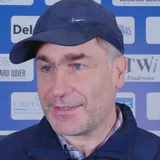
Vassily Ivanchuk
On his day, no one on earth was stronger — and no one ever knew which day that would be. Vassily Ivanchuk plays chess the way weather happens: brilliant beyond reason one round, unrecognizable the next, governed by an inner climate all his own. Peers gave him a name for it — Planet Ivanchuk — because he seems to live somewhere just slightly apart, lost in clouds and calculation, gazing at the ceiling while he sees deeper into a position than almost anyone alive. He beat every World Champion of his era and never wore the crown himself; he is, by wide agreement, the greatest player never to become world champion, and one of the most beloved the game has known.
◈The boy from Kopychyntsi
Vasyl Mykhailovych Ivanchuk was born on 18 March 1969 in Kopychyntsi, a small town in western Ukraine, then part of the Soviet Union. His father was a lawyer, his mother a teacher of physics, and chess came to him as a birthday gift — a magnetic set that opened a door he never closed.
He emerged from the vast Soviet chess machine not as one of its polished products but as something stranger and rarer: a self-taught original with a boundless appetite for the game's every corner. His breakthrough came at the 1986/87 European Junior Championship in Groningen, which he won; the grandmaster title followed in 1988, and that same year, still a teenager, he entered the world's top ten. He has scarcely left it since.
◈The tournament of his life
In 1991, at Linares — the supertournament that crowned the world's unofficial champion of tournament play — Ivanchuk announced himself to history. He won the event outright, ahead of a field that included the reigning World Champion Garry Kasparov, and he did it by beating Kasparov head-to-head, along with the former champion Anatoly Karpov, in the same tournament.
It was a statement no one could mistake: this strange, dreamy young Ukrainian was not merely talented but capable of out-playing the very best in the world on their own ground. By July 1991 he had risen to second in the world rankings — the first of three separate spells at No. 2 across his career, the others coming in 1992 and, at his rating peak of 2787, in October 2007. He would win Linares again in 1995, Wijk aan Zee in 1996, the Tal Memorial in 2008, and great events across four decades.
◈The crown that always slipped away
Three times No. 2 in the world, Ivanchuk never reached the summit on the official list, and he never won the classical World Championship — the one prize his gifts seemed to promise. He came closest in 2002, fighting all the way to the final of the FIDE World Championship knockout before losing to his young countryman Ruslan Ponomariov.
Again and again it was not chess that beat him but nerves. The same volatile temperament that fuelled his brilliance could betray him at the decisive moment — a missed mate-in-one against Anand with nearly a minute on the clock, a sudden collapse in a match he should have won. Chess analysts have long ascribed his failure to win the title not to any gap in understanding but to the burden of his own emotions. He remained, through it all, the strongest player of his generation never to be champion.
◈Planet Ivanchuk
His peers call him "Chucky," and they speak of him with a mixture of awe and tenderness. Viswanathan Anand caught the essence of him: "He's someone who is very intelligent, but you never know which mood he will be in" — and from that came the affectionate nickname Planet Ivanchuk, for a man who seems to orbit a little outside the ordinary world. He has been seen staring at the ceiling during games, pacing, lost somewhere in the position; after a painful loss to Gata Kamsky at the 2008 Dresden Olympiad he was so distraught he kicked a concrete pillar on his way out.
Yet the eccentricity is inseparable from the genius. His opening knowledge is encyclopaedic, his calculation famously deep, and his style restlessly creative — he will sacrifice material after long thought purely to reach an imbalance he finds interesting. He even carried the same total devotion into draughts, taking up the game seriously in his later years. Garry Kasparov said in 2017 that Ivanchuk belonged "in the same category as the world chess champions," and Judit Polgár, asked to name the true geniuses of chess, listed only three: Carlsen, Anand, and Ivanchuk.
◈The pride of Ukraine
If individual glory proved elusive, Ivanchuk found a different kind on the team. He won Olympiad gold twice with the Soviet Union, in 1988 and 1990, and then led independent Ukraine to two of the proudest results in its sporting history: Olympiad team gold in 2004 and again in 2010, with Ivanchuk on the top board, the heart and soul of the side. Across his Olympiad career he scored a remarkable 65.7 percent against the world's elite.
His country honoured him with the Order of Prince Yaroslav the Wise and the Order of Merit. Still competing into his fifties — he won the 2025 Menorca Open — Ivanchuk remains chess's beloved wanderer: a player who chased perfection over the crown, and gave the game, in the chasing, some of the most imaginative chess of his age.
“When I start to play a game I try to forget about previous games and try to concentrate on this game. This game is now the most important to me. If you want to play well, it's important to concentrate on the now.”
“He's someone who is very intelligent, but you never know which mood he will be in.”
“In the same category as the world chess champions.”
◈From the archive
◈Legacy
Ivanchuk's career is the long, luminous proof that genius and the world title are different things. Across more than three decades at the elite level he climbed to world No. 2, won Linares three times and tournaments without number, took the World Blitz crown in 2007 and the World Rapid crown in 2016, and carried Ukraine to Olympiad gold — yet the classical championship always slipped away, lost to nerves rather than to any rival's superior chess. Garry Kasparov placed him "in the same category as the world champions"; Judit Polgár named him, with Carlsen and Anand, one of the game's true geniuses. He is remembered not for a title but for the way he plays — imaginative, fearless, wholly his own — and for a devotion to chess so complete it became its own kind of greatness.