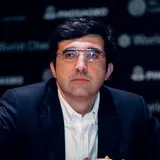
Vladimir Kramnik
Vladimir Kramnik did the thing everyone had stopped believing was possible: he beat Garry Kasparov in a match for the world title. He did it not with fire but with a wall — the dry, ancient Berlin Defence, resurrected and made impregnable — and across fifteen games in London in 2000 the greatest attacker in history could not win a single one. Kramnik was the deep strategist of his generation, a student of Botvinnik who turned opening preparation into a science and the endgame into a fortress, and who held and then reunified the highest title in chess. Where others sought beauty in the storm, Kramnik found it in control.
◈From Tuapse to the Botvinnik school
Kramnik was born in 1975 in Tuapse, a town on Russia's Black Sea coast, to a Ukrainian mother who taught music and a Russian father who painted and sculpted. The talent took him to the most famous classroom in chess — the school run by Mikhail Botvinnik, patriarch of the Soviet game, where a young Garry Kasparov had also been formed.
His arrival on the world stage was abrupt and unforgettable. At the 1992 Olympiad in Manila, still only a FIDE Master, Kramnik was a controversial pick for the Russian team — a choice Kasparov himself pushed for — and he repaid the faith with 8½ from 9 and the gold medal for the best individual performance of the entire event. By January 1996 he had become the youngest player ever to top the world rankings, sharing Kasparov's 2775 rating but ranked above him on games played — a record that stood until Magnus Carlsen broke it in 2010.
◈The Berlin Wall: dethroning Kasparov
In the autumn of 2000, in London, Kramnik challenged Kasparov for the Classical World Championship — the title Kasparov had held since 1985 and defended against all comers. Kramnik's weapon was a shock: the Berlin Defence to the Ruy Lopez, a solid, slightly passive old line that steered the game into a queenless middlegame where Kasparov's attacking genius had nothing to bite on.
“The Berlin Defence suited my strategy for the match,” Kramnik later explained. “I had a defensive strategy… I wanted to try the defensive strategy with Black and it worked so well.” It worked perfectly. Kramnik won the match 8½–6½ — and, astonishingly, did not lose a single game to the most dangerous player who ever lived. Kasparov's fifteen-year reign was over, and the line earned a nickname that has outlived the match itself: the Berlin Wall.
◈Holding and unifying the crown
He defended the title the hard way. In 2004 at Brissago, Péter Lékó led him into the final game needing only a draw to take the crown; Kramnik won that last game to level the match 7–7 and keep the title by the narrowest possible thread.
Then, in 2006 at Elista, came the match the chess world had waited a decade for: a reunification contest against Veselin Topalov to merge the Classical and FIDE titles, split since 1993. It was overshadowed by the bitter “Toiletgate” dispute, in which Topalov's team accused Kramnik of irregular bathroom visits; Kramnik refused to play game 5 under the altered conditions and forfeited it in protest, yet still fought back to 6–6 and won the rapid tiebreak 2½–1½. With it he became the 14th undisputed World Chess Champion — the first man to hold both crowns at once since the schism began.
◈The architect of opening theory
Kasparov described Kramnik's style as “pragmatic and tenacious” — in the latter quality, he said, similar to Anatoly Karpov. Kramnik prized control, deep preparation and flawless technique; he once went some eighty consecutive games without a loss, and his endgame play was among the cleanest of any champion. But his deepest mark was on the openings. He transformed the Berlin Defence, the Petroff, the Catalan and the Grünfeld into mainline battlegrounds of elite chess, anticipating ideas years before they became fashionable. “His stamp on opening theory,” Anand admitted, “is much more significant than mine.”
The crown finally passed in the same arena he had reshaped. Kramnik lost it not in a match but at the 2007 World Championship tournament in Mexico City, finishing second to Anand; his 2008 return match in Bonn ended 6½–4½ to Anand, though Kramnik won game 10 in fine style. He played on at the very top for another decade, reaching his peak rating of 2817 in 2016 — the second player in history, after Kasparov, to cross 2800.
◈Illness, retirement, and after
For years Kramnik played through ankylosing spondylitis, a painful inflammatory arthritis of the spine, before treatment brought it under control. He married the French journalist Marie-Laure Germon in Paris on the last day of 2006, with a church ceremony following in early 2007; they raised two children and made their home in Geneva.
In January 2019, after a difficult Tata Steel tournament at Wijk aan Zee, Kramnik announced his retirement from classical chess. He turned to teaching and to research — working with DeepMind on artificial-intelligence studies of the game, including experimental variants such as no-castling chess designed to refresh a theory he himself had helped exhaust. The champion who had built walls spent his later years trying to open the game back up.
“I am convinced, the way one plays chess always reflects the player's personality. If something defines his character, then it will also define his way of playing.”
“The Berlin Defence suited my strategy for the match… I wanted to try the defensive strategy with Black and it worked so well.”
“His stamp on opening theory is much more significant than mine.”
“Pragmatic and tenacious — in the latter, similar to Anatoly Karpov.”
◈From the archive
◈Legacy
Kramnik will be remembered as the man who ended Garry Kasparov's reign — the only player to beat him in a world-title match — and as the champion who reunified a crown that had been split for thirteen years. The Berlin Wall he built in London changed opening theory permanently, and his pragmatic, deeply prepared, technically flawless chess set the template for the generation that followed. The 14th undisputed World Chess Champion proved that, against even the greatest attacker who ever lived, a wall could be the most beautiful thing on the board.