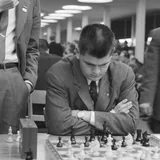
William Lombardy
William Lombardy was the prodigy who, for one perfect summer, looked like the future of American chess — and who then chose, again and again, to stand a step behind it. He won the World Junior Championship with a flawless score no one has matched, beat a future world champion across the board in his prime, and put on a Roman collar at the height of his powers. Most of all he became the steady, brilliant friend at Bobby Fischer's side, the man who carried Fischer to the most famous chess match ever played and asked for nothing in return. His was a life of immense talent given over to others, and it deserves to be remembered for its generosity as much as its genius.
◈A boy from the Bronx
Lombardy was born in New York City in December 1937, the son of an Italian-American father and a Polish-American mother, and grew up in a crowded Bronx apartment. He came to chess late by prodigy standards — around the age of ten, taught by a neighbour — but he came to it completely. By his teens he had found his way into the orbit of Jack Collins, the legendary Brooklyn teacher whose home was a kind of salon for young American talent.
There he sat across the board from another Collins pupil, a boy a few years younger and even more single-minded than himself: Robert James Fischer. The two analysed together for hours, and the friendship that formed over those boards would shape the rest of Lombardy's life. While Fischer dropped out of school for chess, Lombardy studied — three years at City College, and later philosophy and ethics in the seminary — a divided devotion that would define him.
◈The perfect score
In 1957, in Toronto, Lombardy played the World Junior Chess Championship and won it with eleven wins and no draws or losses — a clean 11–0. No player has matched that perfect score in the event's history before or since. He was the first American to win the World Junior, and the first U.S. citizen since Wilhelm Steinitz to capture an individual world chess title. The result brought him the International Master title automatically.
It was in that same Toronto event, against Vladimir Selimanov, that he first tried a quiet idea of his own in the Chigorin Ruy Lopez — advancing the c-pawn a single square rather than two. The novelty, he said, came to him "quite by accident," from simply asking what would happen if Black declined the usual plan. It was characteristic of the man: an original mind, more curious than combative.
◈Leningrad, 1960
Lombardy represented the United States seven times at the World Student Team Championship — an American record — but one campaign stands above the rest. At Leningrad in 1960 he played first board and scored twelve points from thirteen games, a 92 per cent run that took individual gold and helped carry the U.S. team to the title with the highest winning percentage in the competition's history.
Among those he beat that year was Boris Spassky, on Soviet soil, nine years before Spassky would become world champion. The Grandmaster title came to Lombardy the same year. For a moment, on form and on results, he stood among the very best players America had ever produced — and at the U.S. Championship he had already shown he could topple titans, downing the formidable Samuel Reshevsky over the board.
◈The collar and the board
Then, at the height of his strength, Lombardy turned toward the priesthood. He entered Saint Joseph's Seminary, took degrees in philosophy and ethics, and in 1967 was ordained a Catholic priest. He did not, however, stop playing: through the late 1960s and 1970s, often introduced as "Father Lombardy," he kept winning strong tournaments — sharing first at the U.S. Open, finishing second at Monte Carlo in 1969, and as late as 1979 producing a celebrated upset of Viktor Korchnoi at Lone Pine.
He eventually left the priesthood, but never the calling to teach. He ran what was among the first residential chess camps in the United States, lectured everywhere from clubs to West Point, and wrote a shelf of instructional books — Modern Chess Opening Traps, Chess Panorama, Guide to Tournament Chess — culminating in his 2011 memoir, Understanding Chess: My System, My Games, My Life. His advice to students was simple and lifelong: study whole games, beginning to end.
◈Fischer's man in Reykjavík
When Fischer finally reached his world-title match against Spassky in Reykjavík in 1972, it was Lombardy he wanted beside him. As Fischer's second, the priest from the Bronx managed not only the chess but the man — and when Fischer, enraged after a forfeited game, was on the verge of abandoning the match and flying home, it was Lombardy who talked him into staying. Without that, the most famous chess match ever played might never have finished.
He understood his friend better than almost anyone, once calling Fischer "a mystery wrapped in an enigma." Lombardy had been the brighter star first, and there is a poignancy in how thoroughly he gave his gifts to another man's coronation. Frank Brady, who knew them both, put it best: it was "kind of like Mozart and Salieri" — Lombardy might have been the greatest of his generation, if Bobby hadn't come along.
“Fischer was a mystery wrapped in an enigma.”
“It's kind of like Mozart and Salieri. Lombardy might have been the greatest of his generation if Bobby hadn't come along.”
◈From the archive
◈Legacy
Lombardy's last years were hard: evicted in 2016 from the New York apartment he had held for decades, he faced homelessness before the Archdiocese of New York and old friends came to his aid, and he died in October 2017 at a friend's home in Martinez, California. He was portrayed by Peter Sarsgaard in the 2015 film Pawn Sacrifice, and his name endures in opening theory and in the affection of the American chess world. He is remembered as the man who won a championship without dropping a single game, who wore the collar and the grandmaster's title at once, and who gave his rare gifts so freely to his friend that history almost forgot how bright he had once burned on his own.