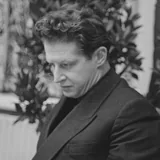
Yuri Averbakh
Yuri Averbakh lived a century, and he gave nearly all of it to chess. He was a Soviet Champion and a World Championship Candidate, but that was only one of the lives he led inside the game: he was also the man who first mapped the endgame whole, an international arbiter, the chairman of his country's chess federation, an editor, a historian, and a memoirist who outlived almost everyone he had ever played. Where others burned out, Averbakh endured — patient at the board, insatiable in study, and still analysing rook endings in his hundredth year because, he said, it kept his mind sharp. To the end he embodied a rare idea: that a chess life could be long, broad, and complete.
◈From Kaluga to the Soviet elite
Averbakh was born in 1922 in Kaluga, southwest of Moscow. His father came from a German-Jewish family whose name was originally Auerbach; his mother was Russian Orthodox. He grew up in the young Soviet state and rose through its formidable chess machine the slow, sound way — without prodigy fanfare, but with a clarity of method that never left him.
He won the Moscow Championship in 1949 and earned the Grandmaster title in 1952. The following year he qualified for the Candidates Tournament at Zurich — the elite eight-week marathon that decided the challenger for the world crown — where he finished joint tenth of fifteen in one of the strongest fields ever assembled. The summit came in 1954, when he won the USSR Championship outright, finishing ahead of a murderer's row that included Taimanov, Korchnoi, Petrosian, Geller and Flohr. In 1956 he tied for first in the Soviet Championship again, losing the title only in a play-off to Mark Taimanov.
◈The art of giving nothing away
Averbakh's strength was control. He played solid, deeply understood chess and made himself maddeningly difficult to beat — the kind of opponent who quietly removed every source of counterplay before the other man knew it was gone. He held lifetime plus scores against opponents as formidable as former world champion Max Euwe and the future champion Tigran Petrosian.
His most vivid description of his own method came in connection with Rashid Nezhmetdinov, the great Tatar attacker whose combinations could demolish anyone given a target. Averbakh simply refused to give him one. “My score against him was something like 8½–½,” he recalled, “because I did not give him any possibility” to attack. It is the perfect epitaph for his style: not the flash of the sacrifice, but the patience to make the sacrifice impossible.
◈Mapping the endgame
If Averbakh's playing record made him a star, his scholarship made him immortal. “My investigative character forced me to make a serious study of the endgame,” he wrote, “that phase of the game where individual pieces battle against each other.” What began as a few articles grew into the first systematic survey of the endgame in the history of the game.
The result was the great anthology that English readers know as Comprehensive Chess Endings — a five-volume reference, expanded from an earlier four-volume Soviet edition, that classified and explained the endgame type by type. For generations of players it was simply the endgame book, the authority you reached for to learn how rook-and-pawn, or knight-and-bishop, actually worked. Averbakh published well over a hundred endgame studies of his own alongside it, and his name was attached to variations in the King's Indian, the Modern Defence and the Ruy Lopez — theory still played at the highest level today.
◈Judge, chairman, editor, historian
No single title contains Averbakh, which is why Raymond Keene called him “the Renaissance Man of chess.” He was named an International Judge of Chess Compositions in 1956 and an International Arbiter in 1969, officiating at the very top of the game. From 1973 to 1978 he chaired the USSR Chess Federation, steering Soviet chess through one of its most politically charged eras.
He edited the leading Soviet periodicals Shakhmaty v SSSR and Shakhmatny Bulletin, and across his life he wrote some fifteen books on strategy, tactics, endgames and the history of the game, plus the memoirs that would make him one of chess's great chroniclers. In February 2020 FIDE named him an Honorary Member — a final recognition of a man who had served the game in nearly every capacity it offered.
◈A century at the board
Averbakh's longevity became a story in itself. He was the first grandmaster ever to reach his hundredth birthday, and even as his eyesight and hearing failed he refused to put chess down. “Sometimes I analyze endgame positions,” he said near the end. “I understand that in the computer age these analyses have no practical value, but this activity helps me to keep my mind sharp.”
His life intertwined with the game's history in quieter ways too: his daughter was for a decade married to his great rival Mark Taimanov. A self-described fatalist, decorated by the Soviet state and honoured again in his final year, Averbakh became the last living link to the heroic age of Soviet chess — a man who had sat across the board from its founders and survived to tell their story to a new century.
“My investigative character forced me to make a serious study of the endgame, that phase of the game where individual pieces battle against each other.”
“Sometimes I analyze endgame positions. I understand that in the computer age these analyses have no practical value, but this activity helps me to keep my mind sharp.”
“My score against him was something like 8½–½, because I did not give him any possibility.”
“The Renaissance Man of chess: a highly successful player, World Championship Candidate in 1953, Soviet Champion 1954.”
◈From the archive
◈Legacy
Averbakh died in Moscow on 7 May 2022, three months after becoming the first grandmaster in history to reach the age of 100. By then he had outlived every contemporary of his playing days and had become a living bridge to the founding era of Soviet chess — a man who had drawn with the giants of the 1950s and was still writing, teaching, and reminiscing into the 2020s. His monumental endgame volumes remain on the shelves of serious players the world over, his name lives on in opening theory, and his memoirs preserve a century of the game seen from the inside. He is remembered not for a single brilliancy but for the wholeness of a chess life: player, scholar, judge, administrator, and witness — the Renaissance Man of the sixty-four squares.